Why have I decided to call my new book Guys like Gauguin?
July 04, 2026
When I was young, I didn’t know much about my grandfather. All I knew was that Robert Keable had been a well-known popular novelist in the 1920s, since forgotten, and that he had run away to live in Tahiti after the First World War, and died there. If I ever told anyone the little I knew, they would invariably say something along the lines of: ‘oh, just like Gauguin.’
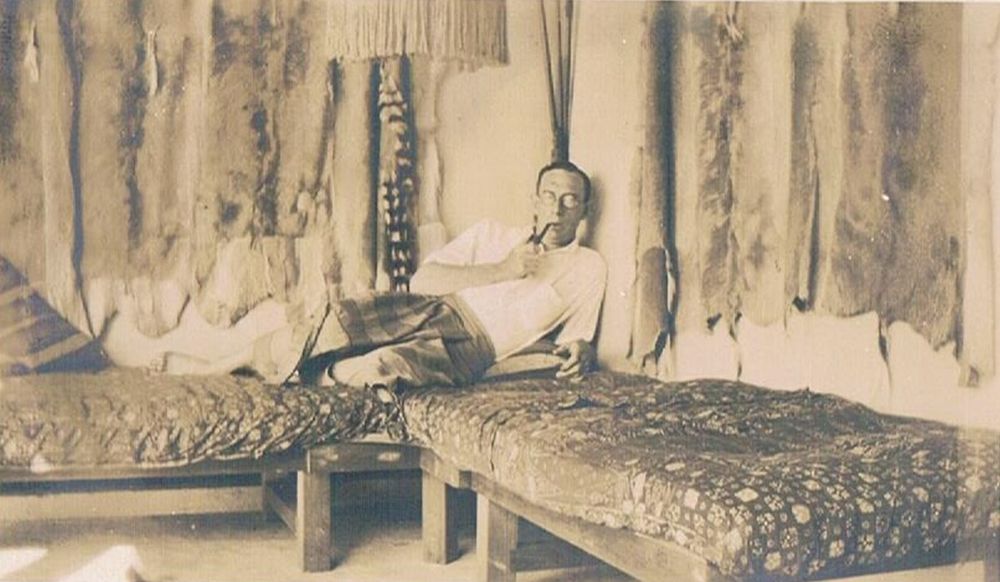
Robert Keable in Tahiti 1927
It all seemed very exotic that my grandfather could be like Gauguin. I didn’t know much about him either, but I knew his paintings were synonymous with Tahiti. In my imagination they had both escaped western civilisation, to live and work on a beautiful remote island.
Four years ago, after 30 years of, on and off, research, I published my book Utterly Immoral, Robert Keable and his scandalous novel. Why Utterly Immoral? Partly because that was what F. Scott Fitzgerald had called Keable’s scandalous novel Simon Called Peter in a review. But also, partly, because I did wonder whether Keable, himself, might have been utterly immoral. There were suggestions that he might have been. There is a story, often repeated in Lesotho even today, that as a priest in Africa he had seduced the young woman playing the Virgin Mary in his church nativity play. Before then, in France during the war, he had an affair with a then 19-year-old lorry driver called Jolie Buck, despite being a married chaplain. After the war, he left the church and his wife and ran away with Jolie to Tahiti. But after Jolie died in childbirth some believed he abandoned his son (my father) in England to return to Tahiti and later disinherited him. In Tahiti I have read reports - admittedly second or third hand - claiming he was very promiscuous and he certainly lived with a Tahitian who had his second child. Does that make him utterly immoral? Probably not, but I was happy to leave that for the reader to decide.
Now after four more years of research, I am about to publish my new book Guys like Gauguin. Why that title?
Gauguin
The French painter Paul Gauguin is forever associated with Tahiti. When he first arrived in 1891, Tahiti was already perceived as a paradise island, but it lacked definitive images. Gauguin provided these. I explain in my book that during his lifetime his work were not appreciated by the French establishment, both in Tahiti and in the leading art galleries back in France. But that within ten years of his death he was being named as one of the founders of modern art, alongside Cezanne and Van Gogh, had acquired a global reputation and his paintings had become very collectible. I also explain that little was known about Gauguin, the man, at that time and that many confused his life and personality with that of Charles Strickland, the fictional painter in Somerset Maugham’s The Moon and Sixpence.
Guys like Gauguin
In my book I look at the lives and work of twenty or so writers and artists who travelled to Tahiti in the 1920s. All of them knew about Gauguin’s link to the island. Robert Keable lived in his old house for a year. James Norman Hall visited Hive Oa in the Marquesas Islands, to see his grave. George Biddle tried to follow him and live, unsuccessfully, like a ‘primitive’. But whether they were actually inspired to go and live on the island by Gauguin is debatable. They all seem to have had different reasons for visiting or settling on the island. For example, Zane Grey was looking for large fish, Caroline Guild for a chance to create a garden, William Alister Macdonald for a good place to sell his paintings, Alec Waugh for sex and Robert Dean Frisbie for a chance to live a remote life.
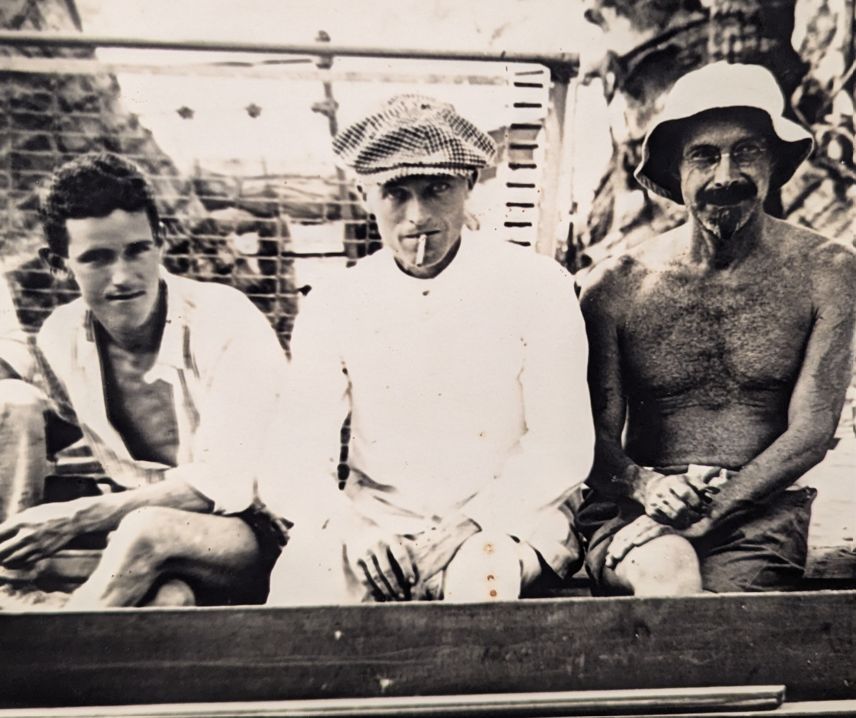
Robert Dean Frisbie, Charles Nordhoff and Harrison Smith in Tahiti
So how are they guys like Gauguin?
First, most obviously, they were either artists or writers – or like Gauguin both – who chose to visit or settle in Tahiti.
Secondly, they were all looking for a simpler life. A chance to escape the hurly burly of the west and to lead a quieter life. For many they were disillusioned with the west following the First World War. Some like Charles Nordhoff, James Norman Hall, Robert Keable, George Biddle and Alec Waugh had served in France and as Nordhoff put it, seen ‘what civilisation has done to mankind.’
Thirdly they were all white and privileged. In some cases, very privileged. They behaved as colonials even if some of them thought they weren’t.
And fourthly they nearly all assimilated, making friends and forming relationships with Tahitians. Many of the men married or lived with South Sea Islanders. Like Gauguin; Octave Morillot, Robert Keable, William Alister Macdonald, James Norman Hall, Charles Nordhoff, Robert Dean Frisbie and the man who called himself Asterisk, all had mixed race children. If anything, these relationships were seen as more scandalous in the west in the 1920s than in Gauguin’s time. Only James Norman Hall felt able to take his partner back to his home country for a visit.
Would anyone wish to be called a guy like Gauguin?
In researching for my book I have, of course, read much about Paul Gauguin. On the plus side he is one of the founders of modern painting, one of the truly great artists. He also campaigned against the poor treatment of the local people in both Tahiti and the Marquesas Islands. And his artistic legacy, with help from Somerset Maugham’s The Moon and Sixpence, helped to make Tahiti a popular tourist destination which has aided the local economy.
On the minus side he had many sexual relationships with young teenagers some of whom bore his child. And his behaviour, and some of his paintings, have helped encourage some tourists to visit Tahiti over the years in search of sex. Some believe that because of his behaviour his work should be cancelled, removed from art galleries and banned from being shown online.
There have been counter suggestions that Gauguin didn’t do anything wrong. That having young partners was acceptable in 1890s Tahiti. I do not believe that. It may not have been illegal, but Gauguin’s behaviour was exploitative and appalling. Remember he was in his forties, married and with four children, when he started having sex with girls aged just 14.
I am not suggesting, by calling my book Guys like Gauguin, that the artists and writers who lived in Tahiti in the 1920s were as guilty as Gauguin of exploitative and appalling behaviour. My aim in writing the book is to detail their extraordinary lives and hopefully present some interesting and entertaining stories about their time on the island. I have tried not to pass judgement on their motives for going to Tahiti, and their behaviour while there. However, I was keen to use the title in the hope that readers will draw their own conclusions as to the extent to which each one of them was, a guy like Gauguin.
Guys like Gauguin will be published on 28th August 2026 by Troubador