How neoclassical artists helped create the image of Tahiti as a ‘paradise’ island
June 11, 2026
In my new book, Guys like Gauguin, I look at the writers and artists who lived in Tahiti in the 1920s. But I begin the book by considering the writers and artists who helped create the image of Tahiti as an island paradise. And I look at how the timing of the ‘discovery’ of Tahiti by Europeans was so significant occurring during the Age of Enlightenment and when Neoclassicalism art was at its peak.
Neoclassicalism
The four major Western art movements between 1600 and 1850s were Baroque, Rococo, Neoclassicalism and Romanticism. To a certain extent each movement was a reaction to what came before and, once accepted by establishment figures, tended to dominate. Neoclassicalism, inspired by Greek Roman art became popular with the excavations of Herculaneum and Pompeii in the 1740s and 1750s. Its heyday coincided with the opening of the Royal Academy in 1768 where neoclassical landscapes, history paintings, formal portraits and classical statutes were displayed.
A key figure in supported Neoclassicalism was Joseph Banks who accompanied Captain Cook on his first visit to Tahiti. He was a member and for almost 20 years secretary of the Society of Dilettanti, which championed the study of Greek and Roman art and encouraged artists who had visited Tahiti to produce grand neoclassical landscapes.
An official artist accompanied Captain Cook on each of his voyages – Sydney Parkinson on the first, William Hodges on the second and John Webber on the third. Parkinson, who had been commissioned by Joseph Banks, died during his journey, probably from dysentery. His illustrations and observations were published posthumously in a book by his brother despite attempts by Banks to delay the publication. Banks was unhappy that an account of the journey was to be published before the official version which would include extracts from Banks’ diaries and he managed to limit the distribution of the book, and the illustrations were not seen by many people. Only recently have people begun to realise the importance of his works as a true first-hand record of the people of Tahiti.
Hodges and Webber however played important roles establishing the image of Tahiti. They had been commissioned, and paid, by the admiralty to record the important events of their journeys with scenes showing the local people, their costumes and dwellings. They both produced very detailed and accurate drawings of dances, rituals, feasts, religious ceremonies, offerings to the dead and the like. But these original drawings were not publicly displayed. Instead, the original sketches were handed to engravers to produce prints that were to be included in the official account of Cook’s journey. Although the engravers were supervised by the two painters, they interpreted the drawings and being accustomed to the then popular neoclassical style of art their final pieces owed as much to the grand paintings on show at the Royal Academy and the classic Greek and Roman styles of art, as to the original sketches. As a result, the pictures were classical in style with Tahiti presented to look like Greece with a tint of tropical exoticism. It was these engravings, published in the accounts and later reprinted in numerous magazines, which played a major role in establishing European and American perceptions of Tahiti. Perhaps most noticeable is the dress of the people, nearly all of whom appear to be wearing togas.
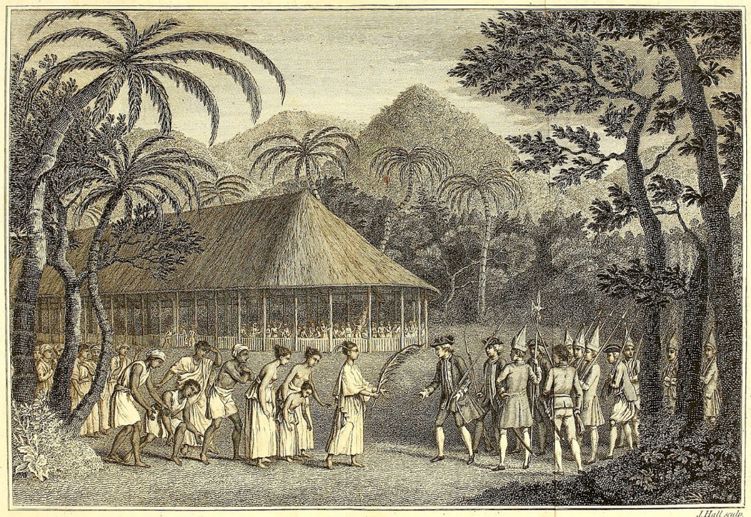
Engraving by Robert Bernard
Also influential were the grand paintings Hodges and Webber produced when back in England. Hodges had been just 28 when he was employed as the official artist for Cook’s voyage. He had worked as an assistant for seven years to the landscape painter Richard Wilson and was clearly influenced by his style of painting. He travelled with Cook for three years, making hundreds of sketches and paintings of the islands and indigenous people. When he returned to England, he not only supervised the engravings of his works he also produced some large-scale paintings based on the voyage, all commissioned by the Admiralty. Of all the places Hodges visited – including New Zealand, Easter Island, Tonga islands, New Hebrides, New Caledonia, Norfolk Islands, Cook Islands and Hawaii – it was Tahiti that most interested him.
The year after he returned home Hodges had three paintings displayed at the Royal Academy, two of which were landscapes of Tahiti. The first A view of Matavai Bay in the island of Otahiete is now owned by Yale Centre for British Art. Their website describes the painting:
Hodges… used his sketches to create resplendent paintings that were instrumental in establishing the vision of Polynesia as an untainted tropical paradise in the European mind’s eye. This classical depiction of Matavai Bay would seem to equate Tahiti with a mythical Arcadia. Nowhere in this picture can one glimpse a Western officer or vessel. Rather, the focus is on the physical and sensual ease of the young Tahitian men in the foreground and the three magnificent Tahitian war galleys in the middle and far distance.
Intriguingly Hodge repainted the scene for the Admiralty adding two British ships – the Resolution and the Adventure – in the middle distance and replacing a Tahitian man in the foreground with woman, with European features, naked to her waist and holding a small child. Although these changes allowed one to see the dominate position of the British over the Tahitians, they did nothing to diminish the feeling that some sort of classical paradise had been re-discovered.
The second Tahiti painting shown at the Royal Academy in 1776 was A view taken in the bay of Oaite Peha Otaheite (also known as Tahiti Revisited). The original is now on display at Anglesey Abbey. In the painting the terrain has been exaggerated with jagged mountainous peaks in the distance. Several female figures are included prominently in the foreground bathing and reinforcing the ‘landscape as an image of sensual paradise with erotic charms.’ By not including any evidence of Cook’s party Hodges gives the scene greater dignity. The Royal Museums Greenwich website suggested that:
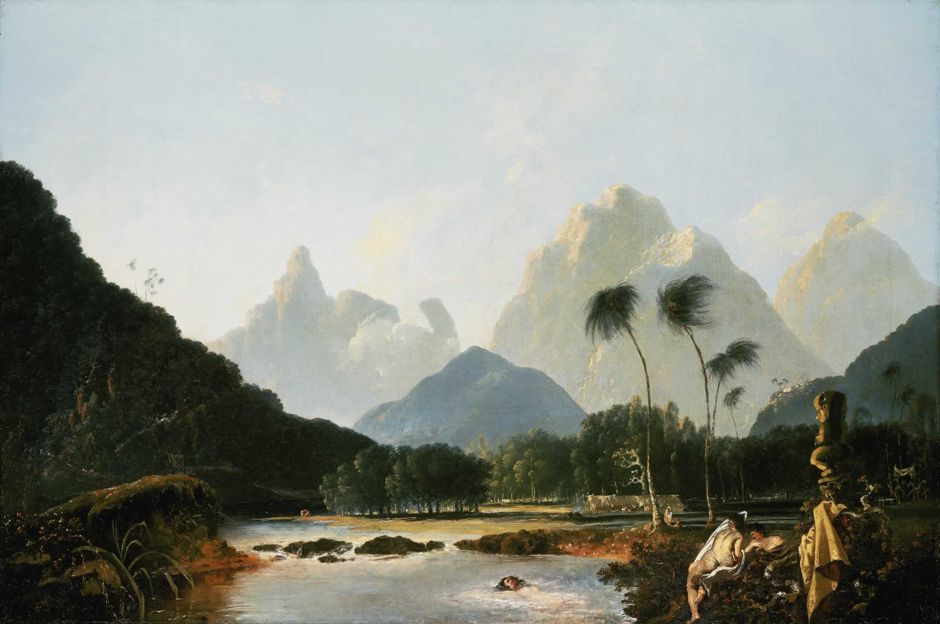
Tahiti Revisited by William Hodges
Such emphasis on the idyllic condition of Tahitian society prior to European contact was a political view that Hodges would have been wary of revealing, and was certainly not the view his works were expected to disseminate. Hodges used this personal interpretation of Tahiti to hint at the heady temptations of the island, which both Cook and the Admiralty would have wished to play down.
Hodges was recognised as an important artist in his day and his paintings attracted considerable public interest when they were shown at the Royal Academy. The Royal Academy summer exhibition was first organised in 1769 and has been an annual event ever since. Very quickly it gained a reputation as the most important exhibition each year and was attended by many visitors. Hodges’ Tahiti pictures also appeared in expensively illustrated books and later many magazines featured illustrations based on his works.
Hodges’ Tahiti paintings are less well known today than perhaps they should be because none of them were purchased by any of the major galleries in the United Kingdom. This was because he continued to be employed by the Admiralty, on 250 guineas a year, so they kept all of them. For many years the paintings hung in the private rooms of the Admiralty although now some can be seen in the National Maritime Museum, which opened in 1937.
John Webber was the official artist on Cook’s third voyage, the journey on which Cook was killed. As with the second voyage Cook and his crew spent three months on Tahiti allowing Webber to produce many sketches and drawings. On his return in 1779 Webber supervised the work to produce 79 engravings covering the journey. Only about ten of these focused on Tahitian subjects but they included portraits of Tahitians, scenes of interactions between Cook and the local people and landscape views. Webber had studied at both the Académie Royale in Paris and the Royal Academy Schools in London before he went on the voyage – and he worked with European engravers so, unsurprisingly, the final prints lent on European traditions. Some of the costumes worn by the Tahitians in the engravings could easily have been seen at balls in London at the time. One engraving by Francesco Bartolozzi, based on a drawing by John Webber shows a Tahitian woman wearing a large high skirt, her right breast unnecessarily bare. The exotic background and flamboyant skirt indicate the subject matter, but the woman’s features could easily be those of a European.
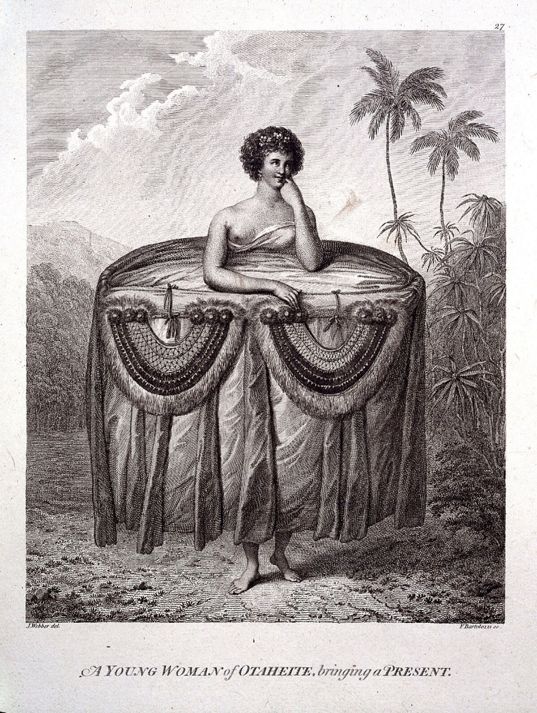
Engraving by Francesco Bartolozzi
Like Hodges, Webber turned a number of his sketches into paintings, and he exhibited around 50 works at the Royal Academy between 1784 and 1792, although only a few of these were inspired by his drawings made in Tahiti. One landscape, A view in Otapheipeha Bay in the Island of Otahaite, he gave to the Royal Academy as part of his application to become an R.A. In the foreground of the painting are three Tahitians, loosely painted and downplayed but behind them is a glorious arcadian view. The contours of the landscape are faithfully copied from his sketches, but the foliage is invented to aid the composition.
One of his most striking images, displayed at the Royal Academy in 1785, is a portrait of Poedua the daughter of a chief from one of the Society islands near Tahiti. Poedua wearing a white drape of tapa cloth beneath her bare breasts and long black hair, looks out of the picture at the viewer. As a writer at the Maritime Museum points out:
Webber has adapted a pose with strong allusions to the attitude of Venus Pudica, the ‘modest Venus’… Through such classical statuary, regarded in the 18th century as a model of female beauty, he implies Poedua stands for womanly beauty. This affirms the comparison between the South Seas as an idealized idyll and perceptions of the classical.
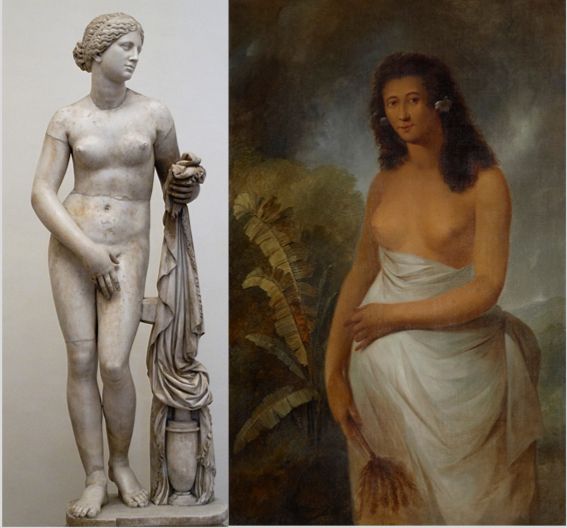
Venus Pudica and John Webber's portrait of Poedua
Webber did not paint an accurate portrait of a Tahitian woman of noble birth. He adapted his painting to suit the conventions of the Royal Academy. ‘The exotic elements are suggestively blended into a mood of sensuous eroticism evoked by the lush, alien vegetation and sultry sky.’ The flowers in her hair suggest earrings which were often included in portraits of indigenous figures at the time to symbolise exotic ‘otherness’. At the time Polynesian women tended to wear just one flower in their hair – on the left if married or on the right if single. This portrait was the first major work by a European of a Polynesian woman and as O’Reilly, an expert of the art of Tahiti, pointed out ‘an anthropologist could easily mistake her for an Italian or Maltese woman.’
The fact Poedua is bare breasted in the painting is significant. Only women seen as outside the conventions of respectable society (such as portraits of Nell Gwyn in the seventeenth century) would be painted in this way. Clearly Poedua was not being presented as an equal to European women.
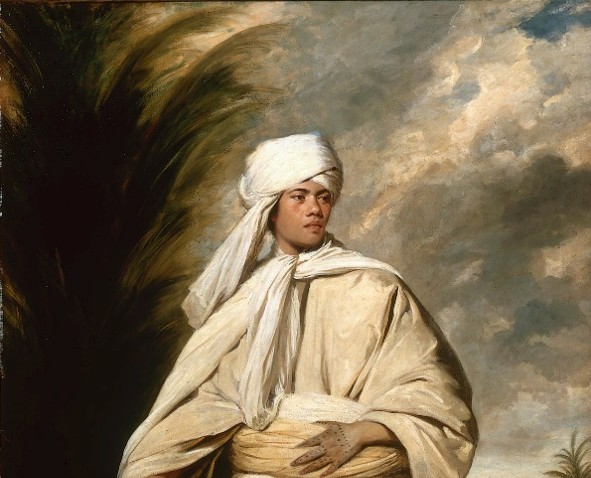
In marked contrast the first major portrait of a Polynesian man, The Portrait of Omai, painted by Sir Joshua Reynolds in 1776 was far more respectful. Mai, called Omai by the English, was a native of Raiatea who met both Wallis and Cook in Tahiti and was rescued by the HMS Adventure from the island of Huahine and travelled back to England where he stayed for two years. Mai was supported by Joseph Banks, who he had met on Cook’s first voyage, and became a favourite in London society. Several different artists painted him including William Hodges, William Parry and Nathaniel Dance but it was Reynolds painting, who was by then the leading artist in Britain and the president of the Royal Academy, which is most famous.
The painting is very impressive. Dr Lucy Peltz, the Eighteenth-Century curator at the National Portrait gallery, claims it
‘is the most important portrait in the history of British art. It is the first portrait of a person of colour painted with dignity, grandeur and agency’.
Mai is presented as a noble prince. He is wearing a long white tunic with a tapa sash a traditional ceremonial Tahitian dress associated with nobles. The costume’s similarity to a toga allowed Reynolds to produce a picture influenced by classical statutes. According to Peltz the pose is similar to the statue of the Apollo Belvedere, a prized classical Roman sculpture that Reynolds saw in the Vatican Palace when he went on the Grand Tour. It is also very similiar to a famous sculpture of Tiberius from the 1st century AD. Mai holds his hands, one pointing down the other across his waist, to show off his tattoos. The background is imagined, invoking what the British believed the South Pacific looked like. It could again be Greece with added palm trees.
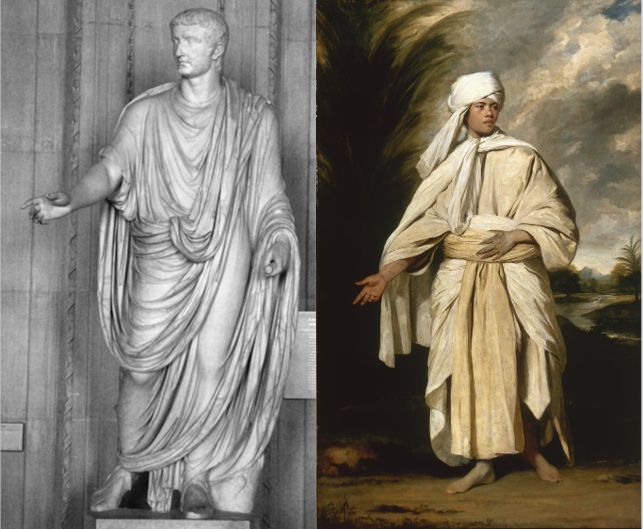
1st century statue of Tiberius and Reynolds’ Portrait of Omai
By painting Mai dressed in white, Reynolds was ensuring his painting would stand out in the darkened rooms of the Royal Academy when it was shown in 1776 – listed as Omiah in the 1776 catalogue[i]. Today the painting is ‘widely regarded as an object of singular national and international cultural importance.’ It was never sold in Reynolds lifetime, but William Dickinson produced a mezzotint engraving which helped to spread the image more widely.
The popularity of the painting at the time, shown just 9 years after the ‘discovery’ of Tahiti shows us just how quickly people in the Eighteenth century were willing to conceive that the people of Tahiti were of a higher status than indigenous people from other South Pacific islands or indeed much of Africa.
So, the pictures of Tahitians and Tahiti produced by or copied from the works of Hodges and Webber and others helped to establish people’s image of the island. An image that was as much based on antiquity as it was reality. The fact that the first visits to Tahiti coincided with the beginnings of mass printed media meant that the pictures and stories about Tahiti were seen by many people. These pictures made Tahiti perhaps unique as a place which, following its discovery by Europeans, acquired and retained an image. As I go on to show in my book Guys like Gauguin part of the reason the image endured was because popular writers and artists who visited the island later, decide to ignore changes and perpetuate this initial impression.