How famous was Robert Keable in 1920s New Zealand?
July 22, 2025
Just how famous was Robert Keable in New Zealand and how popular was his bestselling novel?
Robert Keable, Simon Called Peter and New Zealand
Simon Called Peter was first published in the UK in April 1921. The book caused quite a sensation in England as people started to realise that a former Church of England priest and World War One chaplain had written a novel about a military chaplain having an adulterous relationship with a nurse, in France, during the war. Although the novel was presented as an honest account of life behind the lines in France, the fact that it included some very – for the 1920s – salacious scenes, set in a hotel bedroom only added to the interest in the book. The book was reviewed in a number of publications, for the most part unfavourably. The British Weekly suggested the book reeked of ‘drink and lust’ and the Guardian called it ‘offensive.’ Unsurprisingly then, the book was a huge bestseller.
New Zealand
News of the book had reached New Zealand by October 1921. The first announcement, that the book was ‘arriving shortly’, appeared in the Otago Daily Times. The advertisement proclaimed:
God or Mammon? An old question and at the same time one eternally new. Simon Called Peter is the newest and most stirring answer to this oldest and most modern problem. The most delicate, the most beautiful and the most outspoken love story of modern fiction.
Mr Keable’s hero, a padre in France, goes among publicans and sinners to find God and his own soul. He finds Julie! Julie is love. God is love. How Peter equates his passion and his faith, how he passes through the fair valley of woman’s enchantment to the calvary of self-abasement and self-sacrifice – that is the story of Simon Called Peter.
I do not know how long it took for the first editions to arrive in New Zealand, but the papers only started to carry adverts for the novel about six months later by which time Keable’s second novel Mother of All Living had also been published. The first indication that Simon Called Peter had captured the imagination of the New Zealand public came in a review for the second novel in June 1922. The reviewer wrote:
Keable writes always with daring frankness and at times leaves one gasping at the audacity with which he uncovers the methods of the female of the species, Simon Called Peter was devastatingly frank (and) carried one away by the force of its sincerity, so that long before the daring but beautiful close was reached the reader was accepting the fiction as biography and forgetting that there was any imaginative skill in the author’s pen. Every word of Simon Called Peter rang with truth—at not one stage was the illusion of reality weakened by theatricalism.
Over the next few weeks, there were a few adverts for the novel placed by local bookshops but interest in the novel only seems to have taken off following Keable’s visits to Australia and New Zealand towards the end of 1922. The visits were first announced in New Zealand on November 10th 1922:
Mr Robert Keable, a young novelist, who has already achieved success by the publication of two novels, one of which Simon Called Peter is in its 66th edition is on his way to Tahiti.
When Robert Keable arrived in Australia the local press welcomed him to their country as a famous author, and he was featured in a number of stories. One story in the Sun was headlines:
Keable’s Misfortune, Haven’t Seen Enough of Our Girls, They know how to Frock
In the story he was quoted on his views on the issues such as the correct skirt length, whether women should sunbath on their backs on Bondi beach and whether Spanish, Australian or English women were more attractive. He later claimed that a journalist doorstepped him late at night, so he had no idea what he said.
It was however his views on marriage, divorce and religion, following a lecture he gave in Sydney, which received the most coverage both in Australia and in the New Zealand papers.
The Otago Daily Times quoted part of his lecture at length.
I feel perfectly certain that the world is moving on to a new conception of morality… The old view that marriage is a church sacrament ordained by Almighty God has gone by the board. We know perfectly well it is a contract entered into between two individuals for their mutual advantage. Like every other contract, it ought to be dissoluble at the will of both parties.
My ideal of the relations of man and woman is this: If they are attracted to each other, they swing together, and quite frankly tell their friends, 'We are in love with each other and are going to live together.' If relationship is spoiled, then they should part. The State should register all such contracts if only to ensure that wrong use would not be made of such a slack law. If married people do not love each other, yet continue to live together, it is gross immorality.
Unsurprisingly this opinion came under attack from the clergy in Australia and New Zealand. A number of New Zealand papers carried the view of an Australian priest, under the title:
Modern Marriage, Cleric condemns divorce
A prominent Sydney cleric, Archdeacon Martin, has made an interesting contribution to the controversy on modern marriage, and has censured the Press for the prominence given to the views of the visiting novelist, Mr Robert Keable, author of Simon Called Peter. Regarding Mr Keable himself the speaker said he always had grave doubts about ex-clergymen, who, having taken sacred vows, not only turned their backs upon them, but upon the great truth of religion itself. The agitation for easy divorce, he said, was no new thing. It was centuries old and had led not only to the breaking up of family life, but the breaking up of Empires. Our civilisation was founded on family life. Mr Keable said that if married people did not love one another, yet continued to live together, it was gross immorality. ‘Well,’ asked the Archdeacon, ‘what is it when they cease to live together?’ In eight years there have been 3054 divorces in this State. Each of these divorced persons, he claimed, on the authority of Christ’s teaching, was living in adultery if he or she re-married. ‘I look upon divorce as an attempt to give respectability to adultery, nothing else,’ he said.
The Archdeacon went on to suggest that ‘attacks on marriage were attacks on the home and the family … and almost entirely attacks on the Bible and the church.’ And he suggested that extremists like Keable were doing ‘tremendous harm to the working men of Australia.’
A letter to the New Zealand Herald carried on in the same vein.
Sir, in the Herald of November 30 you publish the views of Mr Robert Keable, ex-minister of the Church of England, on marriage and divorce. One is pleased to find that a man with such infamous and perilous views is out of the grand old historic Church of England. ‘The modern conception of marriage’ if Mr Keable’s be ‘the modern conception’ is certainly calculated to ruin morally, socially, and economically any country that adopts it. His view of marriage is both immoral and selfish. Is marriage only ‘a contract entered into between two individuals for their mutual advantage?’ Surely all right-thinking men can see how false and narrow and selfish such a conception is.
The letter went on to suggest that the ‘increase of divorces is a symptom, and a very significant one, of moral and social decay and decline.’ The example the Roman Empire was used with the suggestion that it was only after the Roman empire had:
bought wealth and effeminacy and idleness in its train that divorces became so common that women counted their years by their husbands and Rome gradually, but surely, fell info weakness and rottenness and ruin.
The letter was signed by Rev J. Farquharson, a prominent Baptist minister from Thames.
In the early 1920s the church in New Zealand was a powerful institution with over 90% of the population members of one of the Christian denominations. However less than half the population were regular churchgoers and Keable’s views, seen by some as an advocate for immorality, do not seen to have affected the warm welcome he received when he arrived in New Zealand.
Keable visits New Zealand
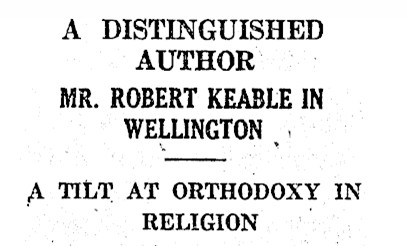
On 15th November the Dominion Newspaper announced that ‘the distinguished author Robert Keable had arrived in Wellington’, suggesting he was the author of ‘two of the most discussed novels of the day.’ In a long article they explained how his experiences during the war had changed his views and had led to him resigning as a priest.
He did not believe that any of the chaplains who went through the war continued to believe in the creeds – in the thirty-nine articles of the Book of Common Prayer. How could they continue to believe that men who were daily showing great qualities in service and sacrifice would be utterly damned because they happened to break one of the Ten Commandments? ... War have shown that nine-tenths of man was good, and out of that good certain rock-bottom principles would evolve which he crystallises in four words – sincerity, fearlessness, service, beauty.
In December the Auckland Star was one of a number of papers who published an extraordinarily positive article about Robert Keable written by the New Zealand born journalist, writer and critic Hector Bolitho. The article was titled:
Robert Keable in Sydney, Simon Called Peter, a great book and an interesting man
Most of the great writers I have met have been a vast disappointments in the flesh. But Robert Keable with whom I browsed on Friday evening, smashes my little theory about great men. He comes like a flood of sunshine from the literary lights of London. . . the afterwar London, which is vibrating with new literary influences, new novelists, and new ideas.
When he wrote Simon called Peter, he was living quietly in Africa. He assures me that he was the person most surprised when the smug English critics accused him of writing a naughty book…
Although he was a pillar of the church for many rears. Mr, Keable has not any evidences of the traditional missionary, or even the orthodox clergyman. Success has not changed him or made him self-satisfied. This. I think, is an enormous achievement, for there is hardly a writer in England at the present time who does not illustrate the appalling tragedy of success…
He had the good sense to get away from it and seek uncharted waters. His books are, in many ways, the most important among recent fiction. He has called his spade a spade, realising that it is far more impressive and sensible than calling it a gardening implement. He realises the mean tragedy of the modern shirking of truth. He has taught us that the nude is cruel only when it is half-veiled…
Robert Keable is a great talker . . . a friendly, deliberate talker. He has the much -mentioned and seldom-found sauce of conversation — a sense of humour. He is deeply religious in the great wide sense. He is very much a boy, and has all the little enthusiasms that lend colour to an interesting personality.
At first, I was interested in him because he had written several great novels. Then I liked him for himself, and during the time we drifted around the harbour on Friday night, watching the pageant of harbour lights, and talking of the things that matter most to those who see hearts throbbing in printers' ink. I realised that in Rober Keable modern fiction has one of the finest minds that has ever enriched the more serious fields of fiction. He is beyond humbug and narrowness. He has forgotten how to sneer and be intolerant, and his heart and eyes are wisely turned to this southern new world, with its untilled ground and vast uncharted waters.
By the time Keable had left Wellington, on his way to Tahiti, after a short stay., there is no doubt he and his novel Simon Called Peter were well known in the country. An article in the Evening Star written in April 1923 gave an indication of how well-known the book was. The journalist was complaining about the fact that the Australian controller of customs had banned the 300-year-old book The Decameron from being allowed into the country. They quoted Mr Wright, acting principal State Libarian who opposed the ban. He said:
Take for instance Simon Called Peter. I think it is an excellent book; but it contains many things which may just as reasonably be objected to as those which are contained in The Decameron. Simon Called Peter is not a book I would give to a girl in adolescence, but I would give it to every young man and woman to read.
By May 1923 new editions of Simon Called Peter were being advertised in newspapers as a ‘famous novel.’ In June, Kirkcaldie’s, the famous department store in Wellington, was claiming that ‘owing to the extraordinary demand for Robert Keable’s novel Simon Called Peter’ they had sold out their first shipment in a few days. ‘A further supply had now arrived’. A month later they were advertising ‘Simon Called Peter, Robert Keable’s famous novel’ was ‘still in strong demand. A few copies can still be obtained from Kirkcaldie’s’.
For the next few months Simon Called Peter was advertised by bookshops throughout the country and his new novels Mother of all Living and Peradventure were also promoted. The following year the sequel to Simon Called Peter, Recompense arrived in New Zealand. A book review reported:
This is a sequel to Simon Called Peter a book which caused quite a flutter of excitement at the time of its publication.
In January 1925 Recompense was turned into a major Hollywood movie, made by Warner Brothers, starring two major stars of the day – Monte Blue and Marie Prevost. As far as I have discovered the movie, although a big success in America with almost 1 million people seeing it, was never shown in the UK. The movie was however released in New Zealand in May 1926 with quite a fanfare. Adverts in the papers boasted the film was
The greatest love story ever told. A love that blinded, scourged, cleansed and glorified a man and woman on the verge of disaster.
It was also claimed:
Since the publication of Robert Keable’s sensational novel Simon Called Peter the reading public has been demanding insistently the rest of the story. Mr Keable offers it in Recompense. One would go far to find a more notable story of the crystallisation of character. The lives of Peter and Julie develop into a climax that is astonishing, yet inevitable. In Recompense there is all the bold courage in telling of life and love that made Simon Called Peter a storm centre. Here is the tale of what followed that tempestuous weekend in London. Few love stories are so alluring and unusual as this one.
It seems the movie was popular with adverts claiming sell our audiences.
Over the next few years Robert Keable’s name occasionally appeared in the New Zealand papers often to record his comings and goings from Tahiti. The topic which generated the most column inches came out of an interview Keable gave in America when on his way back to England in 1926. Speaking to the press Keable had been quoted as saying that during his four weeks on Rarotonga he had seen more drunkenness than ever before in his life. His comments were cabled to New Zealand. Since the Cook Islands were under a New Zealand protectorate and in theory had strict prohibition laws the comments caused some degree of consternation in the country. A Dr Buck, was quoted as saying
It can be confidently asserted that no abuse to the extent indicated in the cable message exists. Bush beer is made secretly by a few persons; such conditions will always exist; but it is impossible for a visitor to come into contact with the beer drinking' unless he is specially invited to such a party, Such statements as that in the cable message and that published in San Francisco are an unjustifiable slur on the people and Administration, and mislead the general public.
There were calls for Keable to apologise.
At the beginning of 1928 the New Zealand papers announced the death of Robert Keable. The longest obituary appeared in a Napier paper under the heading:
Death of Keable, Considerable interest created in Napier, Searching for paradise in Tahiti
Before giving a brief outline of his career, they wrote:
Considerable interest was created in Napier by. the cabled report of the death at Tahiti of the novelist, Robert Keable, particularly as the ideals of that brilliant young man caused a sensation some four years ago, when his first book, Simon Called Peter, sold like hot cakes over the counters of Napier bookshops,
As an Anglican curate, Keable saw service in the trenches in France, and his attitude toward things bearing vitally on life was said to have been revolutionised by that experience. It was held by some that the author' s social creed was embodied in Simon Called Peter, and that it did little to enhance any respect the public may have had for the writer. Despite this, however, Simon Called Peter was an undoubtedly ‘best seller,’ though the following work, Recompense was scarcely so successful,
Keable was in New Zealand some time ago, bound from Australia to Tahiti, where he declared he hoped to find an earthly paradise, ‘far from the maddening crowd's ignoble strife.’
Whether he found in the French colony that happiness cannot be said, for according to those who have visited it, Tahiti holds much to counteract its scenic charms. A Napier gentleman who visited Tahiti about six months ago found Keable peacefully settled in a picturesque home about six miles out of Papeete, with an open-air residence covered with tropical vines and hung with native ornaments. He did not seek society in Papeete to any extent and was certainly not one of those who visited the quay whenever the mad steamer called twice a month,
Reports say that those with whom he came in contact liked him, and though he may have been an eccentric plot former as far as his stories are concerned, he was, so those who met him say, esteemed as a thorough gentleman in private life.