
Guys like Gauguin - COMING SOON
March 21, 2025
Guys like Gauguin, my book on British and American ex-pats who moved to Tahiti in the 1920s, published by Troubador is coming out in August 2026.
My interest in 1920s Tahiti arose out of research into the life of my grandfather, Robert Keable. I was particularly intrigued by his book Tahiti, Isle of Dreams. Keable arrived in Tahiti at the end of 1922 with his common-law wife Jolie Buck, having just separated from his newly converted catholic wife Sybil. He spent the first few months completing Recompense, his sequel to his first novel Simon Called Peter before he turned his attention to writing about Tahiti.
He certainly didn’t need to write the book. He didn’t need the money. The success of his first three novels, published in the space of 18 months had earnt him – in 1922 – at least ten times his annual teacher salary.
And he was fully aware that at the time there wasn’t, obviously, a need for another book about Tahiti. He wrote:
Of the making of books upon the South Seas there is no end, and there probably will be no end for a long time… of books about Tahiti in especial there might be thought to be enough… It has been written up from the geographical, the historical, the missionary and the romantic standpoint – especially the romantic.
However, he went on to suggest that there may be a gap in the market for a book looking at the dreams which attracted the great artists and writers like Loti, Gauguin, Robert Louis Stephenson and Rupert Brooke to come to the island and the reasons why they did not stay.
His intention from the start was to show that the island had been ruined by western civilisation. He argued throughout the book that visitors to the island were attracted by an unrealistic dream. And he explained the reality.
The old Tahiti is as dead as the Middle Ages. Its people have been exterminated, its beauty has been ravished, and its very tradition almost obliterated. The tourist of a day or even of a month sees no more of the real Tahiti of the past than he would see at a well conducted Colonial Exhibition. If he wants amorous adventure he had much better go to Paris. If he wants primitive simplicity he had better go … to Central Africa. And if he wants to get every material necessity for nothing he had better shoot himself [and go to] the Astral Plane.
If that wasn’t damning enough, he went on to explain:
The average young tourist who comes to Tahiti runs an even greater chance of contracting venereal disease then anywhere else in the world. The average lunatic in search of a simple life usually leaves in six months to rid himself of elephantiasis or something worse. The individual who, with the best will in the world, seeks in Tahiti an easy life, almost certainly departs broken-hearted in less.
Not surprisingly Keable’s American publisher decided not to publish the book explaining to Keable’s agent ‘the book would not have sufficient appeal for the American public to warrant Putnams publishing it.’ Keable must have expected this. He explained earlier in the book:
A friend of mine, a young and struggling author, recently sent home articles and photographs of Tahiti. His agent submitted his stuff to the magazines, and wrote to him of the result. In effect he said: ‘They say you write well and can easily market your goods. But if you photograph, your pictures must show no sign of a telegraph pole or a motor-car, and if you write you must not abuse that conception of a real South Sea island which recent writers have done so much to inscribe on the public mind and which the public wants.
One might expect, after all his negative comments, that Robert Keable would have copied his literature heroes, like Robert Louis Stevenson and Rupert Brooke, and after a short stay would have left the island forever. But he continued to live on the island, building his own house and eventually marrying a Tahitian princess Ina Salmon. And he was not the only one to move to Tahiti.
William Alister Macdonald, born in Scotland, but living in London was 60 when he left his wife Lucy and their 11-year-old son and moved to Tahiti. Like Keable he had achieved success, as a well-respected water colourist, part-time teacher and sometime art dealer. Like Keable he ran away with a younger woman, (Dorothy was 31, Jolie 23), who at the first opportunity took his surname. And like Keable he settled in Tahiti and when his new partner departed – (Dorothy went home after three years, Jolie died in childbirth after two), he lived with a Tahitian woman and they had a child together.
Keable and Macdonald did not know each other before they ran away and there is no actual evidence they knew each other in Tahiti, although it seems inconceivable that they did not meet. They did however both meet and become good friends with two Americans who moved to Tahiti in 1920. Charles Nordhoff and James Norman Hall did not exactly run away to Tahiti. They were sent to the island by Harper’s Magazine to write articles which were later collected together in the book - Faery Lands of the South Seas. But they both stayed on, Nordhoff for twenty years and Hall for life. Both were the same age as Robert Keable. Both married local women whose Tahitian mothers had European partners. Christianne’s father was Danish, Sarah’s English.
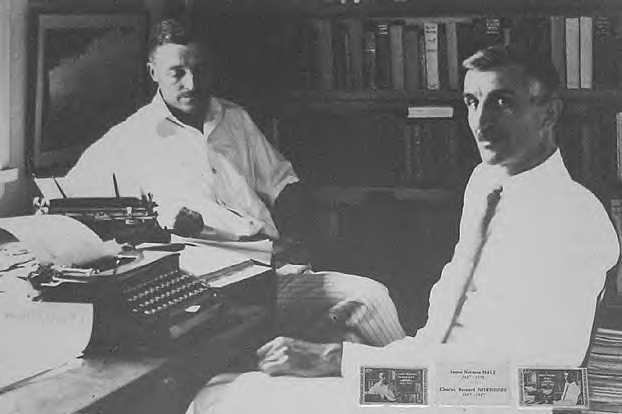
And there were others too who moved to Tahiti and the nearby islands in the 1920s. Robert Dean Frisbie; Viscount Jack Hastings; Caroline and Eastham Guild; Harrison Smith and more. And some who came for extended visits like George Biddle, Alec Waugh and Elinor Mordaunt. Who were these people? There are thousands of islands in the South Pacific and more than 130 sizable islands (over 100 square kilometres). Tahiti is the 44th biggest. Why did they choose Tahiti? As I further investigated I started to realise there was a craze for the South Seas and particularly Tahiti in the 1920s, fuelled by books, newspaper articles, photographs, movies and a tourist boom.
So I had the basis for my book. How did Tahiti acquire and keep its isle of dreams or paradise island reputation? What was the 1920s craze? And who were all these writers and artists who settled on the island in the 1920s?
And writing about these men and women now in the 2020s seems particularly apt. The coronavirus lockdowns in 2020 and 2021 have changed people’s, and business’s, outlook on work. Going into the office is no longer seen as essential for many workers and there has been a big increase in the number of people moving abroad and taking their work with them. It has been estimated that today there are over 35 million digital nomads. Tropical islands are a popular location. To an extent this group of artists and writers were ahead of their time, travelling with typewriters or paint and canvas instead of laptops. Their desire was not to stay connected but instead escape from the rest of the world. But then again is that so different from what many of us would like to do today?
Guys like Gauguin will be published by Troubador in August 2026